The No Business 100 is a 102.2 mile loop between Tennessee and Kentucky. The remote course is about 90% single track trails, and traverses the Big South Fork National River and Recreation area in both states, as well as Tennessee’s Pickett State Park. The terrain is remote and mountainous, and the course is named after a former coal camp called “No Business,” which by one bit of lore was named as such because the miners had no good reason to settle in such an inhospitable and remote place. The race is in its 5th year, and is quickly earning a reputation in the distance running community as one of the premiere 100 mile races east of the Mississippi river. A big part of the growing appeal is that the course is one giant loop in an area that’s logistically challenging to hold a race. Just driving the perimeter of the course could take as long as three or four hours on the mountain roads, and many of the aid stations require all terrain vehicles to resupply. Given the remote challenges of this course, the race directors have earned a reputation for doing an excellent job with logistics, supplies, volunteers, medical professionals, search and rescue, and the overall race atmosphere.
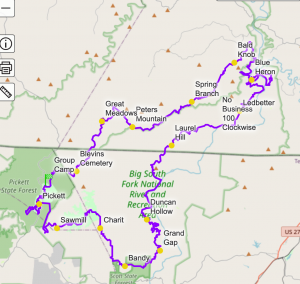
I signed up for the race when registration first opened on January 1, 2021, and within 48 hours the race had sold out. The course is capped at 240 registered runners, and participants are allowed to have crews and pacers. I chose to run this race “screwed,” meaning that I would have no crew or pacers. I made this choice because I wanted the logistical challenge of being responsible – and personally to blame – for my own race, after having the opportunity to be crewed by my friend Bill at my first 100 mile race in 2019. Without Bill’s invaluable help crewing me from mile 25 to the finish at Canal Corridor, I highly doubt that I would have finished. I made mistakes back then like losing a water bottle and such that would have ended my race had he not been there. So, this time around, part of the challenge was to be completely responsible for myself, which at this race put me in the minority of runners.
Why No Business
People asked me at the race why I picked No Business as my main 100 for this year, and there’s a few reasons. The most important is that Big South Fork is a special place for our family. It’s not too far from where we live, a little over two hours driving time from Lexington. I first started coming here six years ago on a solo hiking trip, and since then our family has gone back two or three times a year. It’s a beautiful and quiet piece of wilderness that’s off the beaten path, and is a special place for our family with many happy memories. Jan and Lior didn’t need any convincing to come down and stay in a cabin while I raced. If somebody asked Lior what his favorite place in the world is, he’d probably say Charit Creek Lodge, an 1830s homestead owned by the National Parks Service that’s located inside Big South Fork NRRA.
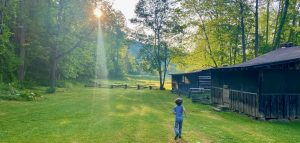
The place has no electricity or cell service, and anyone that wants to stay needs to hike on single track for about a mile and a half to get there. One of the aid stations for the race is located just outside the lodge, and a big plus of the race is that I ran on about 30 miles of trails that we’ve hiked as a family. The course, for me at least, is imbued with really great memories and has been on my mind for years. Given the recent popularity of the race, I was worried that in future years I’d never get a spot. I could easily see this race in five years becoming as popular in this area as the Hardrock 100 is out west, and I wanted to run the course before.
Preparation
Going into No Business, I had what I think was my best block of training in the last five years. I had around 1700 running miles since January 1, with a lot of interval training and hills for the first six months. I raced the Big Turtle 50 Miler in April, the Night Owl Trail Marathon in June, and the Bluegrass Reaper 50K in August. I came in 11th place overall at the Night Owl, and 10th place overall at the Bluegrass Reaper. I also had a steady amount of cross training with the post-vaccination return of pools in March, and plenty of road and mountain biking, hiking, kayaking, and gardening. For three months prior, I ran at peak 60 to 70 miles per week with a focus on cross training and avoiding injury. I felt physically prepared going into No Business, and mentally, especially after the last two years, I was looking forward to 33 hours without email. My friend Alex remarked that it’s really something that somebody chooses to run 100 miles to avoid email for a day and a half, and he has a point.
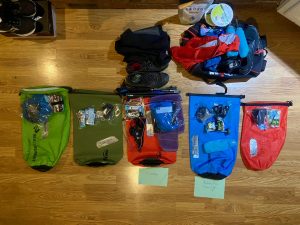
In addition to physical and mental preparation, I had to strategize five drop bags worth of supplies. This included planning all the gear, nutrition, and medical that I could possibly need:
- Peters Mountain | MILE 14.4 | DROP BAG #1 – Socks, gels, bars, peanut butter sandwich
- Blue Heron | MILES 33.1 and 39.5 | DROP BAG #2 (I reach this drop bag twice) – Socks, gels, bars, peanut butter sandwich, headlamp + extra batteries, charging stick + cable for watch
- Duncan Hollow | MILE 64.7 | DROP BAG #3 – Change socks and change into new shoes, Pickup new headlamp and waist, Gels / bars, Beanie / gloves, Peanut butter sandwich, hiking poles, waist and headlamp
- Bandy Creek | MILE 76.7 | DROP BAG #4 – Socks, gels / bars, fresh baked challahSawmill | MILE 88.5 | DROP BAG #5 – Socks, gels / bars, fresh baked challah
Race Week
We drove down from Lexington on Thursday and stayed in a cabin I booked back in January 2021, about 30 miles from the start/finish line. That was about the closest lodging to the start line beyond state park cabins or camping, and that distance and location worked for us.
The night before the race I did packet pickup and drop bag deposit with Lior, and we were back at the cabin by 7PM CST. The race started the next morning at 8AM CST on Friday. The plan was I’d get up at 6AM CST, eat, and then Jan and Lior would drop me off at the start line and then do a few short hikes on Friday and Saturday. This all went according to plan. I laid out all my race materials for the morning, ate challah and microwave pho for dinner, and went to bed around 8PM CST. Overall I slept well. I did wake up for about a half hour in the middle of the night when the power went out, but I do think I slept for around seven hours.
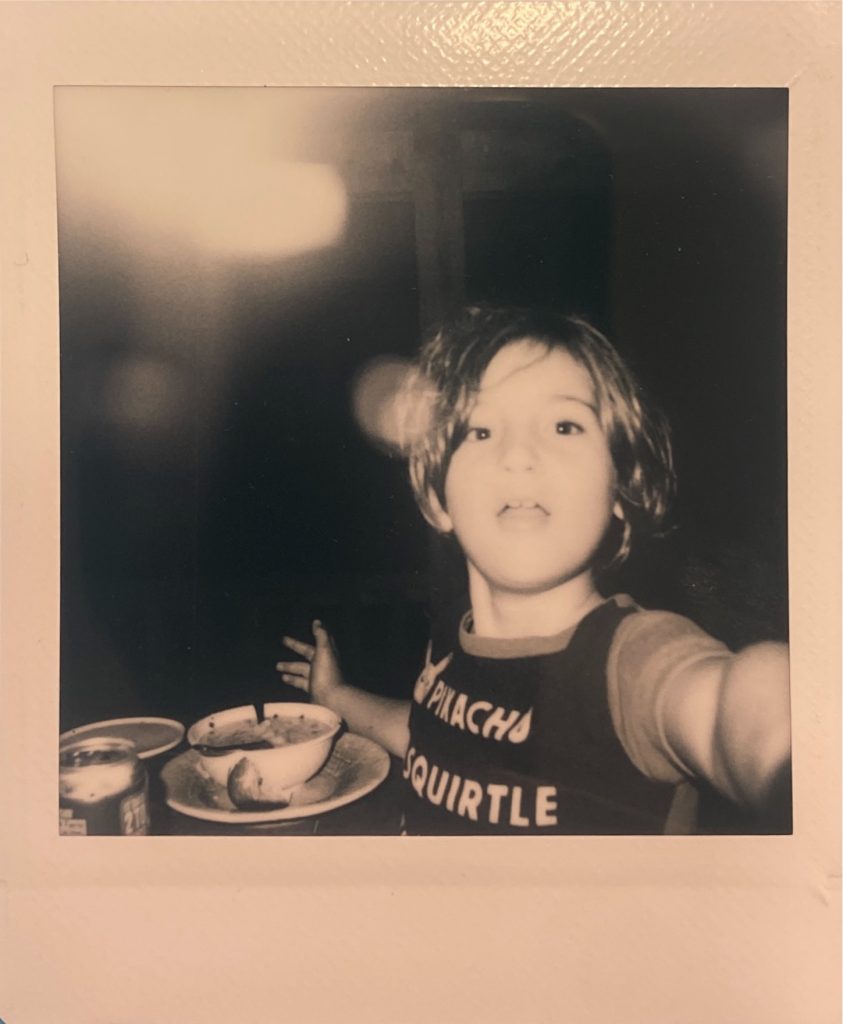
In the morning, I ate another small loaf of challah and pho, went to the bathroom, and then Jan and Lior drove me to the start line, arriving by 7:40 CST.
Of 239 registered runners, 206 started. The atmosphere at the start line in Pickett State Park was festive with sponsor booths such as Hoka. I ran into another local Kentucky distance runner that I’d met at other races and we caught up. He had hooked me up with his friend’s registration at the Big Turtle 50 Miler this past spring after I mistakenly showed up, forgetting to register for the event. The temperature in the morning was cool and sunny, probably in the mid 60s Fahrenheit, and throughout the remainder of the daylight hours I don’t think the temperature went over 80f. For the first ten miles we were backed up on the trails, with runners queued up on the single track with little room to pass. However, the bottleneck did help to regulate pace and ensure that I didn’t overcook myself in the beginning. At mile three there was a creek crossing, and my shoes went under the water. I stopped at the first drop bag at mile 14 to change socks, and this would be the theme of the next 32 hours: change socks at every drop bag, and later at deeper water to take my socks and shoes off and carry them over my head. By keeping my feet as dry as possible, I was able to avoid any significant blistering for the entire event.
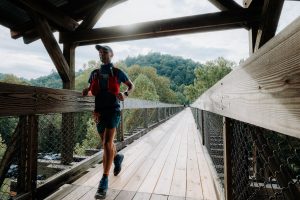
I won’t do an hour by hour account, but I’ll summarize and say that there were no surprises for the majority of the event in terms of nutrition or my physical performance. My heart rate stayed in low zone two for 32 hours, although my watch battery did finally die around mile 75 so I don’t have biometric data from after that point. At times I ran with people, some that I knew from other events, and we talked about running and life. As the night approached at mile 45, I grouped up with a pack of runners from Ohio that I recognized from other events and we talked. Later after mile 65, I grouped up with some runners that were crewing a 67 year old woman named Ruth on her first 100. We kept the conversation going about plants, gardening, and the outdoors to distract Ruth from dropping, and I am happy to say that she finished. To get a sense of the night time atmosphere, here’s a video of the mile 65 aid station that one of the race photographers shot:
In the above video, this is one of the aid stations that has a medical doctor so the video shows quite a few runners at their worst.
After mile 65, I had two close calls with copperheads but they were mostly on the move, visible, and avoidable. Probably the most adrenaline intensive moment though was running into a momma black bear with two cubs at 4AM (close to mile 70). She was on the edge of the trail bobbing her head at us and had absolutely no interest in stepping aside without her cubs. Eventually there were about ten runners backed up, and we were collectively able to make enough noise and motion with our hands to persuade her to climb up a tree with her young ones. I’ve never seen a family of bears climb a tree before (They’re fast! Really, really fast!).
As dawn approached at mile 74, I was back to running on trails that were familiar to me from hiking with Lior and Jan over the years. There were many happy memories and my spirits were high, especially when I ran past Charit Creek Lodge at mile 82 and then Twin Arches. At my last drop bag at Sawmill, I recognized all the aid station volunteers from Kentucky and they cheered me through the station. I took some time to sit for a moment, dry my feet off, and change socks. After Sawmill, I had a section of rock arches and shelters on the loop back to Pickett State Park. At this point I had been awake for close to 30 hours, and during that section I saw mirages – I’d look at boulders up ahead and see busses, then tell my brain that those are actually rocks, and then the rocks would appear as rocks. This went on for about a half hour, and during that time I had the strong urge to curl up on the side of the trail and sleep. At a certain point though, perhaps around mile 94, I felt awake again and ran without issues for the rest of the event. I picked up the pace at mile 95, and at mile 96 I actually ran into Jan and Lior at a rock shelter in the middle of the woods! They had hiked to a spot they had been before to see me and cheer me on, and I was able to hug them both. I was so happy to see them both I cried after we parted ways. An hour later, I passed mile 100 and cursed the race directors for making the course an extra 2.2 miles in length. But with 40 minutes to spare before the cutoff, I approached the finish line to see Jan and Lior waiting for me, crossing at 4:22 CST for a total of 32 hours 21 minutes 33 seconds, finishing 96th out of 206 that started and 111 that completed the race.
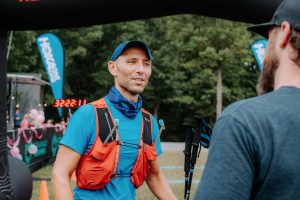
At the finish line, the race director greeted me and asked me what I thought. I told him that this was a really fun course and he laughed.
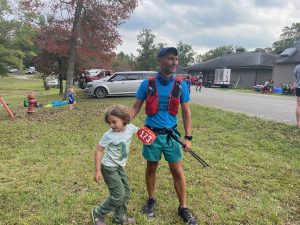
We didn’t stick around long at the finish line and drove back to the cabin. I had a steak waiting for me and I fired up the grill, cooked my steak, and was in bed by 8PM CST. In the morning we woke up at 5am, packed up the car, and I drove us back to Lexington so Lior could go to Hebrew school. We stopped for donuts on the way back, and I am happy to say that I was able to walk to and from the donut shop with few problems. I had no blisters or significant soreness from the race, and the following Thursday I took Lior on a three day backpacking trip without any problems.
I’m left with good impressions from this event. Despite a few miscalculations involving my drop bag logistics, everything else went well. During the race I used every pair of socks that I packed, ate every peanut butter sandwich, and changed shoes at what I think was the appropriate mile marker. I did however make some logistical mistakes that could have been more serious. For example, I underestimated when I would hit the nighttime section and I should have put my very best headlamp and 800 lumens waist lamp in my mile 40 drop bag. Instead, I had my best torches in my mile 65 drop bag. Given that it was near dark when I left the mile 40 aid station, I had 25 miles worth of technical trail with my mediocre headlamp. That said, I did appreciate the change of visual perspective at 2:30am when I finally reached the mile 65 drop bag and put on the bright lights. Jan and Lior had a great time at the cabin and hiking in my absence, and I didn’t injure myself racing and thoroughly enjoyed the course. I’m especially grateful to Jan and Lior for humoring me with another big adventure, and for Bill and Stuart for listening to me plan the course out for months on end. Bill was also able to provide Jan with the important pace information to help find me at mile 96, and he kept them up to speed throughout the event on how I was doing. Thanks to them all, and especially to the disinterested copperheads and the momma bear that chose not to maul me.